Northern Staffordshire Bull Terrier Club Of New Zealand 

Breed Info


Breed Standard 

General Appearance: Smooth-coated, well balanced, of great strength for his size. Muscular, active and agile.

Characteristics:  Traditionally of indomitable courage and tenacity.  Highly intelligent and affectionate, especially with children.

Temperament:  Bold, fearless and totally reliable.

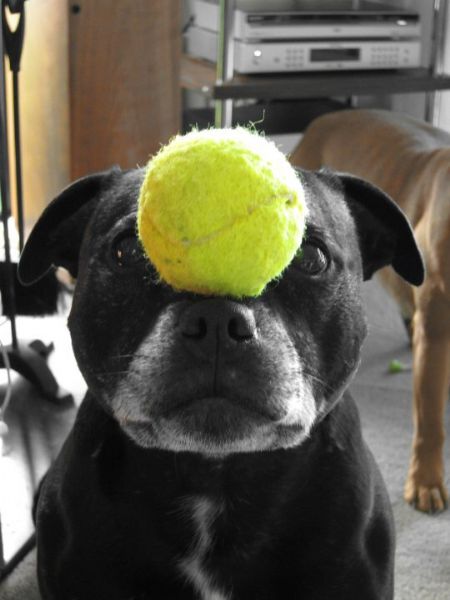
Head and Skull:  Short, deep through with broad skull.  Very pronounced cheek muscles, distinct stop, short fore face, nose black.

Eyes:  Dark preferred but may bear some relation to coat colour.  Round, of medium size, and set to look straight ahead.  Eye rims dark.

Ears:  Rose or half pricked, not large or heavy.  Full, drop or pricked ears highly undesirable.

Mouth:  Lips tight and clean.  Jaws strong, teeth large, with a perfect, regular and complete scissor bite, i.e. upper teeth closely overlapping lower teeth and set square to the jaws.

Neck:  Muscular, rather short, clean in outline gradually widening towards shoulders.

Forequarters:  Legs straight and well boned, set rather wide apart, showing no weakness at the pasterns, from which point feet turn out a little.  Shoulders well laid back with no looseness at elbow.

Body:  Close - coupled, with level topline, wide front, deep brisket, well sprung ribs, muscular and well defined.

Hindquarters:  Well muscled, hocks well let down with stifles well bent.  Legs parallel when viewed from behind.

Feet:  Well padded, strong and of medium size.  Nails black in solid coloured dogs.

Tail:  Medium length, low set, tapering to a point and carried rather low.  Should not curl much and may be likened to an old fashioned pump handle.

Gait / Movement:  Free, powerful and agile with economy of effort.  Legs moving parallel when viewed from front or rear.  Discernible drive from hind legs.

Coat:  Smooth, short and close.

Colour:  Red, fawn, white, black or blue, or any of these colours with white.  Any shade of brindle with white.  Black and tan or liver colour highly undesirable.

Size:  Desirable height at withers 35.5 - 40.5 cms (14 - 16 ins.), these heights being related to the weights.

Weight:  dogs: 12.7 - 17 kgs (28 - 38 lbs); bitches 11- 15.4 kgs (24 - 34 lbs)

Faults:  Any departure from the foregoing points should be considered a fault and the seriousness with which the fault should be regarded should be in exact proportion to its degree and its effect upon the health and welfare of the dog.

Note:  Male animals should have two apparently normal testicles full descended into the scrotum


Is A Stafford Right For You? 

The Stafford is now a hugely popular dog but before you make contact with a breeder and purchase your puppy you really need to ask yourself 'Is a Stafford the right breed for me?'.

The Stafford is well known for its love of humans and most especially children.  He is most happy when on your lap and surrounded by his human family.  He will quite happily spend time with children and indeed they are well known for their love of children - however - this does not make him a childrens dog!  A child should never be left alone to play unsupervised with a Stafford (or any breed of dog) and should not be allowed to walk a Stafford on their own.  The Stafford has great strength for his size and only has to spot something in the distance and he's off!  A child is unable to restrain an adult Stafford with his mind firmly set on getting to where he wants to go.  As the Stafford is such a robust and energetic breed, children also need to learn boundaries and 'Stafford manners' so as not to be hurt by an overexcited 20kg ball of muscle! 

A Stafford needs to be with his people and does not thrive as a backyard dog with minimal human contact.  Most Staffords do not realise they are Staffords and instead see themselves as a four legged human.  They can be quite needy and if they become bored or lonely can quite easily turn destructive or into escape artists.  Involve your Stafford in your day to day routine and family lifestyle and you'll have a happy Stafford.  They are quite happy to go for jogs, walks, the beach or just as happy to sit with you on the sofa.  The central theme here being as long as they are WITH YOU!

Due to his love of humans, Staffords do not often make good guard dogs.  Whilst he may look somewhat intimidating a Stafford is more often than not likely to show your burglar where the good silver is and then hop in the car after him for the ride.  So if you are looking for a dog to be protective of the home - the Stafford is NOT it!

You must always keep in mind that the Stafford was originally bred as a fighting dog.  Although this barbaric sport is no longer legal - the Stafford still retains his history.  Whilst a Stafford may not always start an altercation - he will more than likely always be the one to finish it.  He is not the type of dog you can run off lead down at the local park.  A Stafford will not generally be aggressive indiscriminately but nor will he back down if challenged and he never forgets! 

The Stafford has many positive virtues.  He is a great family dog, he is a clown, he is undyingly loyal and if brought up correctly will make you the perfect companion for the duration of his life.  He is a wonderful breed but he is not the breed for everybody.


Puppy Buying Tips

The average price for a NZKC registered puppy is between $800-$1200

Colour and sex DO NOT determine the price of the puppy.  There is no such thing as a rare colour.  Acceptable colours in the breed include red, fawn, white, black or blue, or any of these colours with white.  Any shade of brindle or any shade of brindle with white.  Black & tan or liver colour are highly undesirable.  Although liver and black & tan are unsuitable for showing and breeding, they still make wonderful pets.

Both parents must be NZKC registered.

The breeder must also be a financial member of the NZKC and have a NZKC approved breeders prefix (eg: kennel name).

When purchasing your puppy, make sure you receive the puppy's NZKC papers at the time of purchase.

Look for plump, bright eyed, active puppies in clean surroundings.

Make sure the puppies have been fully wormed and vaccinated and that they are 8 weeks of age before leaving for their new homes.

Should NZKC papers not be provided at the time of picking up your puppy, ensure you receive a receipt for "pure bred NZKC registered Staffordshire Bull Terrier".  The receipt should include the sellers full name, contact details and NZKC membership number.

Remember that there are a lot of people out there trying to make money by breeding dogs.  These people don't put the welfare of the puppies first and foremost.  You want to find a responsible breeder that puts a lot of time and effort into raising their puppies.  You will be more likely to get yourself a healthier, more well adjusted puppy if you look for a responsible breeder. This will however take time and patience.


Stafford History

Before the nineteenth century, bloodsports such as bull baiting, bear baiting and cock fighting were common. Bulls bought to market were set upon by dogs as a way of tenderizing the meat and providing entertainment for the spectators; and dog fights with bears, bulls and other animals were often organized as entertainment for both royalty and commoners. Early Bull and Terriers were not bred for the handsome visual specimen of today, rather they were bred for the characteristic known as gameness. The pitting of dogs against bear or bull tested the gameness, strength and skill of the dog. These early "proto-staffords" provided the ancestral foundation stock for the Staffordshire Bull Terrier, the American Pit Bull Terrier with the exception of the American Staffordshire Terrier. 

These bloodsports were officially eliminated in 1835 as Britain began to introduce animal welfare laws. Since dogfights were cheaper to organized and far easier to conceal from the law than bull or bear baits, bloodsport proponents turned to pitting their dogs one against another instead. Dog fighting was used as both a bloodsport (often involving gambling) and as an effort to continue to test the quality of their stock. For decades afterwards, dog fighting clandestinely took place in pockets of working-class Britain and America. Dogs were released in a pit, and the last dog still fighting (or occasionally, the last dog surviving) was recognized as the winner. The quality of pluckiness or "gameness" was still highly prized, and dogs that gave up during a fight were reviled as "curs". As an important aside, fighting dogs were often handled in the pit during fights, by both their owners and the judge, so were bred to be as trustworthy with humans as they were aggressive towards other dogs.

It is this nefarious history that gives the Stafford his celebrated temperament, as in the words of the American Kennel Club: "from the past history of the Staffordshire Terrier, the modern dog draws its character of indomitable courage, high intelligence, and tenacity. This, coupled with its affection for its friends, and children in particular, its off-duty quietness and trustworthy stability, makes it a foremost all-purpose dog."The breed attained UK Kennel Club recognition on 25 May 1935. Much of the groundwork to attain this status can be attributed to Joseph Dunn and Joe Mallan. Dunn and Mallan invited friends to a Stafford fanciers meeting at the Cross Guns Hotel, Cradley Heath, South Staffordshire (a hotel owned and managed by Mallan). About fifty breeders met at the hotel and formed the Original Staffordshire Terrier Club. The name was shortly changed to Staffordshire Terrier Club due to the Bull Terrier Club objecting the use of the word 'original'. Stafford were imported into the US during this time. Since that time the breed has grown to be one of the most popular breeds of dogs with a large representation at the Crufts Dog Show. 

The breed attained UK Kennel Club recognition on 25 May 1935. Much of the groundwork to attain this status can be attributed to Joseph Dunn and Joe Mallan. Dunn and Mallan invited friends to a Stafford fanciers meeting at the Cross Guns Hotel, Cradley Heath, South Staffordshire (a hotel owned and managed by Mallan). About fifty breeders met at the hotel and formed the Original Staffordshire Terrier Club. The name was shortly changed to Staffordshire Terrier Club due to the Bull Terrier Club objecting the use of the word 'original'. Stafford were imported into the US during this time. Since that time the breed has grown to be one of the most popular breeds of dogs with a large representation at the Crufts Dog Show. 

In the US many were imported by pit fighters and used in their breeding programs to produce the American Pit Bull Terrier and American Staffordshire Terrier. Many were imported by British nationals who brought their dogs with them or U.S. expatriates who fell in love with the breed in England and brought it home. Eventually through the campaign of many people the Stafford was recognized in the U.S. in 1976. He has a loyal following.


Pictured Above Left:  Joe Mallan and Stowcote Pride                 Pictured Above Right:  Joe Dunn with the first champion Stafford - Ch Lady Eve


Northern Staffordshire Bull Terrier Club New Zealand
Email For Website Enquiries: shannon@cartint.co.nz
Email For Club Enquiries: markcath@ihug.co.nz


Dogz Online - Dogs, Breeders, Puppies